

In this field note
AGI preparedness for businesses is less about predicting when artificial general intelligence will arrive and more about making operations structured enough for advanced AI systems to assist safely. That requires clean workflows, reliable data sources, defined permissions, and human approval gates built into processes before automation expands.
The practical transition follows a sequence: map workflows that create operational drag, establish clear sources of truth for core records, define what AI systems are permitted to read or act on, and test narrow agents inside controlled processes before scaling. Businesses that complete this groundwork reduce manual inefficiency now and build the operational foundation that more capable AI systems will require later.
AGI preparedness should not start with guessing when artificial general intelligence will arrive. For most businesses, the useful work is more practical: make the company easier for any advanced AI system to understand, assist, and eventually operate inside with human oversight.
That means clean workflows, reliable data, clear permissions, useful software connections, and approval gates. If those pieces are missing, a more capable model will not magically fix the business. It will move faster through the same confusion.
AGI preparedness starts with business operations, not predictions
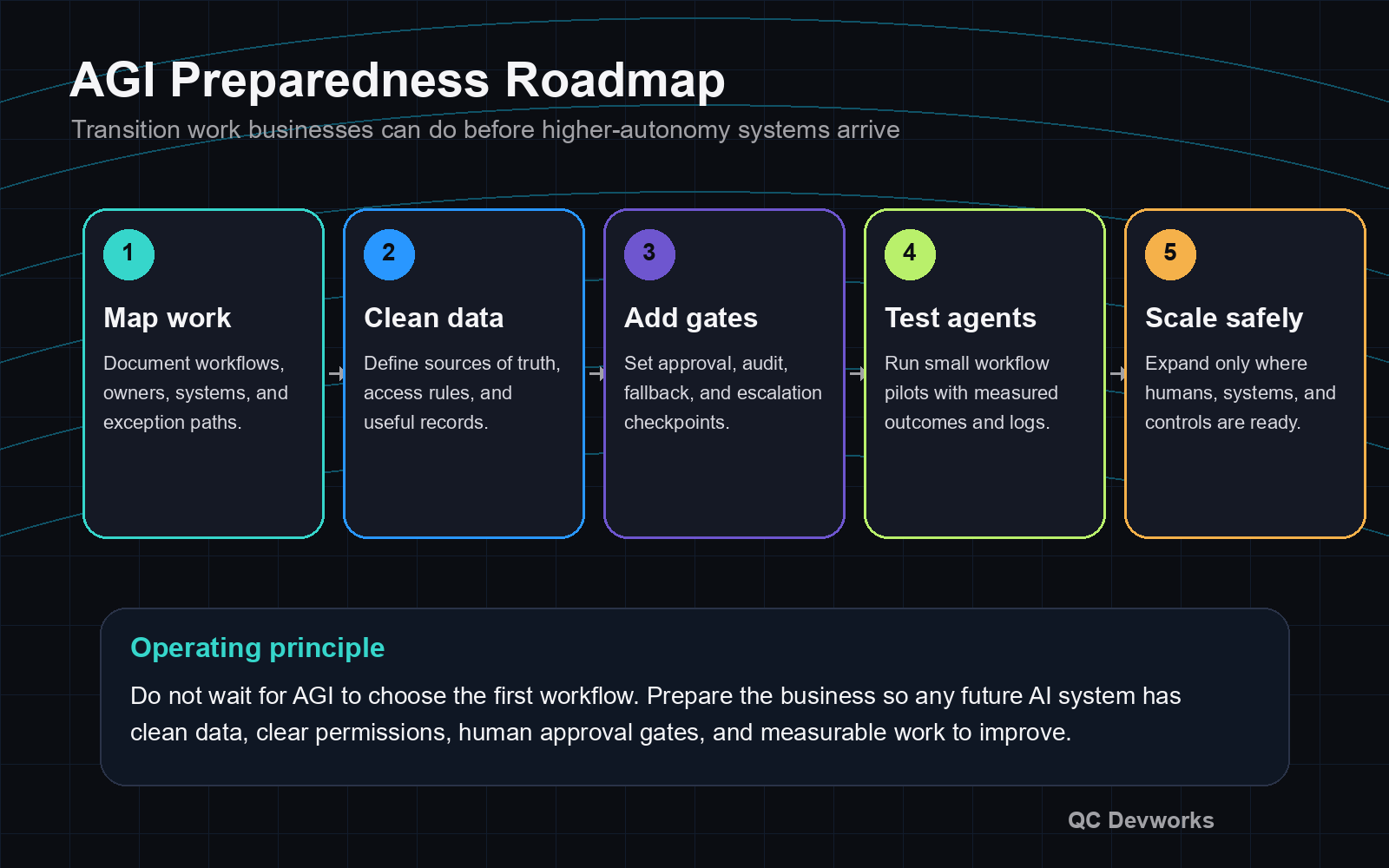
AGI preparedness starts by preparing the workflows a future AI system would need to help with.
There is no responsible way for a small business to build a plan around a fixed AGI date. The term itself is used differently across labs, investors, operators, and policy discussions. The practical question is simpler: if AI systems become more capable, more agentic, and more connected to business software, will your company be ready to use them safely?
As of June 2026, the serious public frameworks around advanced AI focus less on a calendar and more on risk, capability evaluation, misuse prevention, and controls. OpenAI’s Preparedness Framework, NIST’s AI Risk Management Framework, and NIST’s Generative AI Profile all point in the same practical direction: understand the system, govern use, evaluate risk, and monitor outcomes.
For a business owner, that translates into operations work. You do not need to predict AGI to get ready. You need to know which workflows matter, where the data lives, who can approve an action, and what should happen when automation is wrong.
The transition begins before the tools are ready
The businesses that benefit from more capable AI will be the ones that have already made their work legible.
A future AI agent cannot reliably help with quoting if quotes are scattered across inboxes, spreadsheets, handwritten notes, and one person’s memory. It cannot run dispatch cleanly if job status has no source of truth. It cannot help with approvals if nobody can explain what needs approval, who decides, and what record should be kept.
The transition work is not glamorous. It looks like mapping intake, defining statuses, cleaning customer and job records, documenting exceptions, connecting systems, and deciding where humans must stay in the loop. That work helps now, even if AGI never arrives on the timeline people expect.
It also protects the business from a common mistake: adopting AI as another disconnected tool. A chatbot in the corner of the website is not an operating model. A real transition plan asks where AI should touch the work, which actions it can recommend, which actions it can take, and which actions require human approval.
Step 1: Map the work AI would eventually touch
The first step is to map the workflows where speed, judgment, routing, or repetitive decisions create operational drag.
Start with the work that already causes delays. Common examples include lead intake, quote review, service request routing, job scheduling, parts checks, approval queues, follow-up reminders, customer updates, document review, reporting, and owner visibility.
For each workflow, write down:
- Where the request starts.
- What data is required before work can continue.
- Which systems hold the current record.
- Who owns the next action.
- What exceptions stop the process.
- What decisions are routine and what decisions are sensitive.
- What record should exist after an action is taken.
This is where AGI preparedness becomes useful even for a small Quad Cities business. A mapped workflow can become an internal tool, a dashboard, an integration, or a production AI agent later. An unmapped workflow stays dependent on tribal knowledge.
Step 2: Build clean sources of truth
AI transition work depends on knowing which system owns which record.
If the customer name is different in the CRM, accounting system, spreadsheet, and email thread, AI will not know which record to trust. If quote status is updated manually in three places, an agent may act on stale information. If a job can be marked complete without required photos, notes, or sign-off, automation can make the gap worse.
Before a business asks AI to act, it should decide what systems own the core records:
- Customers and contacts.
- Jobs, requests, or tickets.
- Quotes and approvals.
- Calendar events and dispatch assignments.
- Inventory, parts, or service constraints.
- Documents, files, and signed records.
- Reports and operating metrics.
This does not always mean replacing software. Often the better first move is a workflow system that connects existing tools and creates a cleaner operational layer. That is the difference between buying another app and preparing a business for higher-autonomy systems.
Step 3: Define permissions before autonomy
A business should decide what AI is allowed to do before it connects AI to important systems.
There are levels of permission. An AI assistant might summarize a request. A workflow agent might draft a response, prepare a quote packet, or flag missing information. A higher-autonomy system might update a record, assign a task, schedule a follow-up, or create a purchase request.
Those levels should not be treated the same. The business needs a permission model:
- Read: The system can view records and summarize work.
- Recommend: The system can suggest a next action, but a human decides.
- Draft: The system can prepare a message, quote, task, or update for review.
- Act with guardrails: The system can take narrow actions under defined rules.
- Escalate: The system knows when to stop and ask for human approval.
CISA’s Secure by Design guidance is written for software producers, but the operating lesson is relevant for buyers and builders too: security and responsibility should be designed in from the start. For AI-enabled workflows, that means roles, logs, defaults, fallbacks, and escalation paths before broad access.
Step 4: Put human approval gates in the workflow
Human oversight works best when it is designed into the workflow instead of added after a mistake.
Approval gates should match the risk of the action. Low-risk actions might only need logging. Medium-risk actions may need review before sending. High-risk actions should require explicit approval, especially when money, legal language, customer commitments, safety, private data, or operational disruption is involved.
For example, an AI system might be allowed to summarize a service request, detect missing fields, and draft a scheduling note. It should not automatically promise a date, discount a quote, change a contract, or approve a purchase without rules and review.
The goal is not to slow everything down. The goal is to route decisions correctly. Humans should spend less time copying data and more time reviewing the choices that actually matter.
Step 5: Start with narrow agents, not company-wide autonomy
The safest transition path is to test narrow AI agents inside well-defined workflows.
A narrow agent has a specific job, a known data source, a limited set of actions, and measurable outcomes. It might triage inbound requests, prepare quote review packets, compare job notes against required fields, watch for stale approvals, or draft follow-up reminders.
This is different from giving a general AI tool broad access to the business. A narrow production agent should have boundaries. It should know what it can read, what it can write, which tools it can call, what it should log, and when to stop.
That is why QC Devworks often talks about AI agents and automation in the context of real workflows. A useful agent is not a novelty. It is a worker inside a controlled process.
Step 6: Measure transition readiness with operational signals
AGI preparedness should be measured by workflow readiness, not by how many AI tools the business has tried.
Useful readiness signals include:
- Every priority workflow has a named owner.
- Core records have a source of truth.
- Exceptions are visible instead of hidden in inboxes.
- Approvals have status, timestamps, and decision records.
- Important systems can exchange data through integrations or controlled imports.
- AI outputs can be reviewed, corrected, and logged.
- Staff know when to trust automation and when to escalate.
These signals matter because they turn AI from a separate tool into part of the operating system. They also make failures easier to diagnose. If an agent drafts the wrong response, the business should know whether the issue came from bad data, unclear rules, missing context, poor prompt design, or a model limitation.
Manual process vs AGI-ready workflow
An AGI-ready workflow is not fully autonomous. It is structured enough that higher-autonomy tools can assist without guessing how the business works.
| Manual process | AGI-ready transition |
|---|---|
| Work moves through email, texts, calls, and spreadsheets. | Work enters a defined queue with status, owner, and next action. |
| The owner remembers exceptions and checks in manually. | Exceptions are flagged by rules and routed to the right reviewer. |
| AI is used as a general chat tool outside the workflow. | AI assists inside a controlled workflow with clear permissions. |
| Data quality problems are fixed after they cause delays. | Required fields, validation, and source-of-truth rules prevent avoidable gaps. |
| No one knows why a recommendation was made. | Inputs, actions, approvals, and outcomes are logged for review. |
Where QC Devworks fits into the transition
QC Devworks helps businesses turn AI preparedness into workflow systems, internal tools, integrations, and production agents.
That can start with a software waste audit to see where the current stack is slowing the business down. It can become workflow systems that define state, routing, approvals, and reporting. It may require internal tools that give the team one operational surface. It may involve custom software development where the workflow is too specific for off-the-shelf tools.
The important point is sequencing. Do not start by asking, “What will AGI replace?” Start by asking, “What work needs to become clear enough that a human and an AI system can share it?”
That question leads to better software decisions today and a safer transition path tomorrow.
Bottom line: prepare the business, not the buzzword
AGI preparedness is not a bet on a date. It is a way to make the business more legible, connected, and governable before advanced systems get more capable.
Map the work. Clean the data. Define permissions. Add approval gates. Test narrow agents. Measure outcomes. Then scale only where the workflow, people, and controls are ready.
For a Quad Cities business, that is the practical path from AI curiosity to a real transition plan. It reduces manual drag now and creates the operating foundation future systems will need.