
Define
Who uses it, what job it does, what it must survive, and what it connects to. A one-page brief and a feasibility read.
Most product ideas need a physical thing and the software that makes it useful. We design both: the enclosure and mechanism you can hold, and the firmware, app, or dashboard it talks to, with one team and one fixed price per phase.
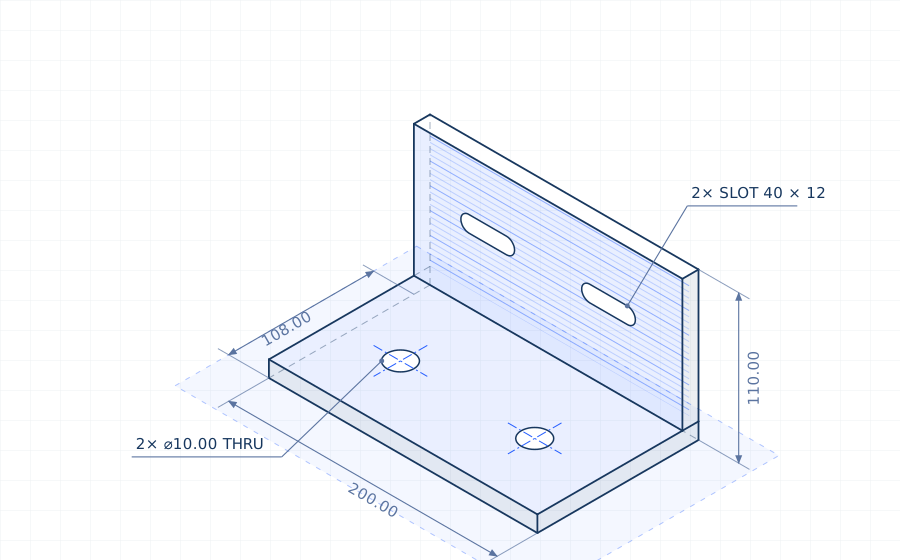
A product is a series of decisions, and each one is cheaper to make on a prototype than on tooling. We break development into phases with a fixed price and a clear deliverable, so you can pause, pivot, or take the files elsewhere at any point.
Who uses it, what job it does, what it must survive, and what it connects to. A one-page brief and a feasibility read.
Industrial design, mechanical CAD, and printed prototypes in quick loops until the form, fit, and mechanism work.
Electronics fit, cable routing, thermal and ingress considerations, then testing with real users and real conditions.
Connected products fail in the software more often than in the plastic. Because we build software for a living, the app, the dashboard, the device provisioning, and the data pipeline are designed alongside the enclosure, not bolted on by a second vendor.
Sensors, controllers, and gateways with the firmware, cloud service, and admin dashboard that make them worth owning.
STEP files, drawings, tolerances, a bill of materials, and print or molding notes a manufacturer can quote from.
Print the first ten or hundred units here to sell, test, or demo before committing to tooling.
Most product failures are decisions made too late: the enclosure that does not fit the board, the app designed after the device shipped, the tooling cut before anyone held a prototype.
Provisioning, connectivity, and the user flow are designed with the enclosure, so the device and the app are one product.
Printed prototypes and small runs prove the design with real users before any money goes into molds.
STEP, drawings, tolerances, bill of materials, and notes. A manufacturer can quote from it without a discovery call.
Each phase has a fixed price and a deliverable you can take elsewhere. Most products need all four; none of them lock you in.
The user, the job, the environment, and the systems it connects to. A one-page brief and a feasibility read.
Industrial design, mechanical CAD, and printed prototypes in fast loops until the form and mechanism work.
Electronics fit, thermal and ingress considerations, firmware and app, then testing with real users.
STEP files, drawings, tolerances, a bill of materials, and notes a manufacturer can quote from. Or a small run printed here.
The housing and the app are designed by the same people, so nothing is bolted on by a second vendor later.
Define, design, integrate, and hand off are scoped and priced separately. Pause or pivot between them.
Delivered at the end of every phase, in formats any manufacturer or developer can pick up.
Either. We can take a product from concept through prototypes and production files, or design a housing around electronics you already have. Software, firmware, and dashboards can be included or left to your team.
Per phase, at a fixed price agreed before the phase starts. Define, design and prototype, integrate and validate, and production handoff each have their own scope and deliverable.
We design enclosures and mechanisms around your boards, handle the software and cloud side, and coordinate with electronics partners for custom PCB work when a project needs it.
You do. Native CAD, STEP, drawings, source code, and documentation are delivered at the end of each phase.
We design around your boards and handle firmware and software. For custom PCB design we coordinate with electronics partners as part of the project, so you still have one team accountable for the product.
Yes. Send what exists: CAD, a prototype, a bill of materials, or code. We assess it in the Define phase and pick up from there rather than starting over.
We design with the relevant requirements in mind, such as ingress ratings and enclosure standards, and point you to the right test lab. Certification testing itself is done by accredited labs, not by us.
Rapid prototyping in the Quad Cities: 3D printed prototypes designed, printed, and revised in days, at a fixed price per iteration, so you can test the idea before you commit to tooling.
CAD design for Quad Cities businesses — production-ready 3D models and drawings for parts, fixtures, enclosures, and jigs, quoted at a fixed price and delivered in days from Moline.
Custom software development for small and midsize businesses: web apps, internal tools, custom CRMs, customer portals, and SaaS replacement.
Tell us what you want to build, automate, or replace. We reply by email with questions or a next step.
Request a quote

