
Measure and document
Calipers, gauges, and reference photos on the original, with critical fits confirmed against the parts it touches.
The machine still works. The one plastic part that keeps it working is discontinued, back-ordered, or priced like a repair. Send it to us. We measure it, model it, improve it, and hand you a replacement and the file to make more.
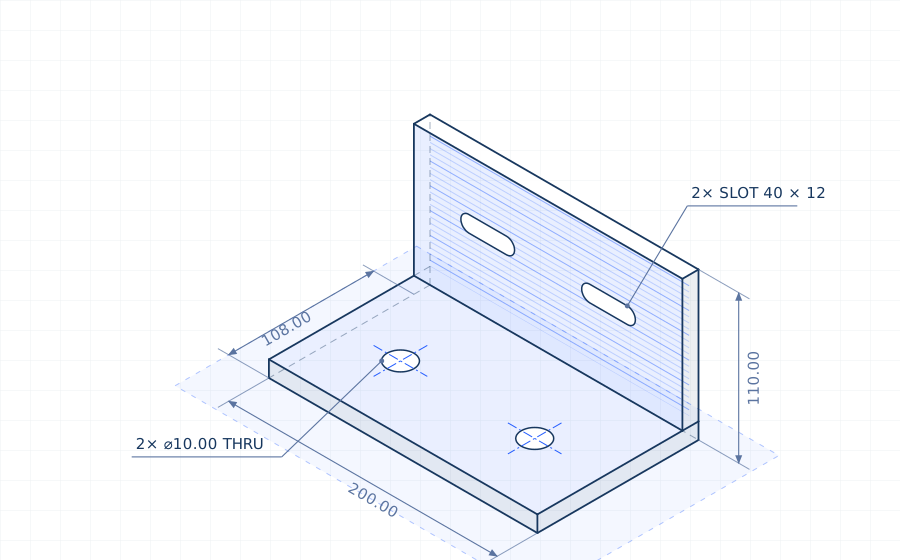
Reverse engineering is measurement plus judgment. We capture the dimensions that matter, the ones that mate with something else, and then decide which features to copy exactly and which to improve: a thicker rib where it cracked, a slot instead of a hole where it bound up.
Calipers, gauges, and reference photos on the original, with critical fits confirmed against the parts it touches.
A clean CAD model, not a scanned mesh, so the part can be adjusted, scaled, or re-toleranced later.
If it broke, we ask why and fix that: material, wall thickness, geometry, or the way it was loaded.
Most requests are plastic and light-metal parts on equipment, vehicles, appliances, and fixtures: the things that fail first and are hardest to source. We tell you honestly when a part should be machined from metal instead of printed.
Knobs, guards, guides, covers, brackets, gears, and housings on production and shop equipment.
Clips, trim, adapters, bezels, and housings that are discontinued or absurdly priced through the dealer.
Fixtures and jigs built decades ago by someone who has since retired, recreated with drawings this time.
The cost of the part is rarely the point. The cost of the machine sitting idle, or of replacing it, is.
A guide, a guard, or a gear recreated in days beats waiting on a part that may never ship.
The original broke for a reason. The replacement gets a thicker wall, a fillet, or a tougher material there.
With the file in hand, spares are a print away instead of a search across resellers.
Send the original, even in pieces. The mates and the failure tell us most of what we need.
Calipers, gauges, and reference photos. Critical fits are confirmed against the parts the original touches.
A clean parametric CAD model, not a scan mesh, so the part can be adjusted or scaled later.
If it cracked, bound, or wore, we change the material, wall, or geometry so the replacement lasts longer.
Printed here in days, or STEP files and a drawing for a machine shop when the part needs metal.
Most single parts are measured, modeled, and printed within a week of arriving.
Send photos and rough dimensions for a quote before you ship anything.
You keep the STEP and print files, so the next one costs a print, not a project.
Ideally yes, even if it is broken. Failing that, the mating parts plus photos with a ruler and a few caliper measurements are usually enough. We confirm the critical dimensions before modeling.
For most mechanical parts, careful measurement and parametric modeling produce a cleaner, more useful file than a scan. Where a scan genuinely helps, such as organic or sculpted surfaces, we use one as a reference and still deliver a proper CAD model.
Making a replacement part for your own equipment is normal practice. We will not reproduce protected designs for resale. If a request looks like it crosses that line, we will say so.
The replacement part, printed here or made by a shop from our files, plus native CAD, STEP, STL or 3MF, and a drawing, so the next one is a reprint rather than a project.
Often, if the photos include a ruler and you can confirm the critical dimensions with calipers. Anything that mates tightly with another part should be measured, not estimated.
Critical fits are held to the tolerance the process allows and confirmed against the mating part. Cosmetic surfaces are matched closely but not obsessively, unless they matter to you.
That is usually the point. We keep the interfaces exact and improve the material, wall thickness, or geometry where the original failed.
CAD design for Quad Cities businesses — production-ready 3D models and drawings for parts, fixtures, enclosures, and jigs, quoted at a fixed price and delivered in days from Moline.
3D printing for Quad Cities businesses — prototypes, fixtures, replacement parts, and small-batch runs printed in Moline, quoted at a fixed price, with local pickup or shipping.
Custom jigs, fixtures, and shop tooling for Quad Cities manufacturers: designed around your operation, 3D printed in Moline in days, and revised for free if the first version is not right.
Tell us what you want to build, automate, or replace. We reply by email with questions or a next step.
Request a quote

